ArmorSim is a 3D terminal ballistics simulator created for anyone interested in understanding what happens when a projectile meets armour. Instead of relying on simple health bars, scripted effects, or visual approximations, ArmorSim focuses on the interaction between projectiles, armour plates, materials, velocity, thickness, angle, and spacing.
The central question is straightforward: will the projectile penetrate?
To find the answer, we can construct a target from individual plates, select different materials, adjust thicknesses and angles, introduce spacing between layers, and then choose a projectile. The simulator includes ammunition from American, Soviet/Russian, and German arsenals, allowing different projectile and armour combinations to be examined inside the same environment.
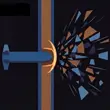
Once the shot is fired, the impact is calculated rather than simply played as a predetermined animation. Penetrator erosion, plate deformation, holes, plugs, fragments, and other effects emerge from the selected physical parameters. The resulting scene can then be viewed in slow motion with an orbiting camera, making it possible to examine the impact from different perspectives.
There are no artificial sparks, glowing effects, or cinematic explosion clouds designed to make an impact look impressive. The emphasis is on the behaviour of metal and other materials under extreme conditions.
Armor Sandbox APK 3D Terminal Ballistics Simulation
ArmorSim provides several simulation approaches, allowing users to choose between fast analytical calculations and considerably more detailed continuum-based modelling.
The available solvers are designed for different levels of experimentation and computational demand. A quick calculation can be useful when testing many configurations, while a more advanced simulation can provide significantly greater information about how an impact develops.
NORMAL Solver for Fast Ballistic Testing
The NORMAL solver is designed for rapid experimentation. It uses analytical terminal-ballistics approaches to calculate an impact without requiring a long computational run.
Its modelling framework includes Alekseevskii–Tate erosion integration, Recht–Ipson residual velocity, a Rosenberg ricochet criterion, and Grady fragmentation.
This makes the NORMAL mode particularly useful when repeatedly changing variables. We can modify plate thickness, material, projectile characteristics, or impact conditions and immediately perform another calculation.
The workflow is simple: build the target, select the projectile, fire the shot, inspect the result, adjust a parameter, and fire again.
For comparative testing, that speed makes the analytical solver especially practical.
ADVANCED Solver for Layered and Spaced Armour
The ADVANCED solver expands on the analytical approach and provides greater visibility into what happens inside complex armour arrangements.
Instead of limiting the experiment to one plate, we can create layered and spaced arrays, introduce reactive armour configurations, and examine the energy behaviour across individual layers.
The solver can report values such as ballistic limit, wear fraction, and residual velocity for each plate encountered by the penetrator. This makes it possible to understand not only whether a projectile eventually penetrates but also where its available energy is being consumed.
For example, a multi-layer target can be examined as a sequence rather than as a single anonymous armour value. Each layer contributes to the final outcome, and the results show how the penetrator changes as it moves through the structure.
This approach is useful for users who want to experiment with armour thickness, spacing, material combinations, and projectile energy without reducing the entire target to one simplified statistic.
ULTRA Solver and Continuum Impact Simulation
The ULTRA solver represents the most computationally demanding mode in ArmorSim. Rather than relying solely on analytical equations, it uses an axisymmetric Lagrangian mesh to model the impact.
The solver incorporates Johnson–Cook plasticity, a Mie–Grüneisen equation of state, adiabatic shear banding, and element erosion.
A simulation can therefore take substantially longer than a NORMAL calculation. Instead of producing an immediate result, ULTRA may require minutes to complete an individual impact.
The benefit is that the resulting damage geometry is generated through the simulation rather than manually drawn as a visual effect. Craters, deformation, material removal, and other impact characteristics emerge from the computational model.
ULTRA is also deliberately limited. Its continuum approach is axisymmetric, and its intended configuration is for head-on impacts. Rather than attempting to produce an answer for every imaginable scenario, the system identifies situations that fall outside the conditions it is designed to solve.
Physics-Based Armour and Projectile Behaviour
ArmorSim does not treat armour as a collection of generic hit points. Instead, outcomes are associated with physical parameters and published modelling approaches.
Material behaviour depends on properties such as density, yield strength, and shock-related data, while projectile behaviour can involve erosion and changes during penetration.
This distinction is important because armour performance is not determined by a single number. Thickness, material properties, projectile characteristics, impact conditions, and target configuration can all influence an outcome.
A plate can deform, develop a hole, eject a plug, or produce fragments depending on the conditions represented by the simulation.
Traceable Material Data
One of the notable aspects of the material system is its approach to documenting material constants.
Material entries can identify whether a particular value is:
-
MEASURED
-
DERIVED
-
FITTED
-
ASSUMED
The associated source information is also identified so that users can understand where the underlying number originated.
This creates a more transparent environment for experimentation. Instead of presenting every value as an unquestionable fact, the simulator provides information about the nature and origin of the data.
Unsupported Materials Are Clearly Identified
Not every armour or penetrator material has comprehensive public experimental data available. ArmorSim therefore distinguishes between supported information and situations where reliable open-literature data is unavailable.
Rather than silently replacing missing information with an arbitrary substitute, unsupported cases are documented.
This is particularly important for anyone using the simulator to compare different materials. A result is more useful when we understand whether the underlying material properties are experimentally measured, derived from other information, fitted to available data, or based on an assumption.
Consistent Results Across the Solvers
Another important design principle is consistency between simulation modes.
The ULTRA solver is intended to provide detailed damage geometry, while the analytical core remains responsible for determining the actual ballistic outcome. This separation prevents different simulation components from independently declaring contradictory penetration results for the same shot.
In practical terms, the visual representation and the analytical result are kept within a common framework.
That makes it easier to use the detailed solver for examining the shape and progression of damage without turning the visual output into an unrelated second answer.
Build Custom Armour Configurations
ArmorSim includes a free-build scene editor for creating custom targets.
Plates can be added, moved, rotated, and assigned different materials. Users can construct single plates as well as more complicated layered and spaced armour arrangements.
This flexibility makes the simulator suitable for controlled comparisons. Rather than accepting a predefined target, we can create a configuration that isolates the variable we want to examine.
Changing plate thickness, introducing additional spacing, selecting another material, or rearranging layers can then be followed by another simulation.
Armour Materials and Penetrator Cores
The material database includes 14 armour materials and 4 penetrator cores, giving users a range of combinations for experimentation.
The simulator also includes kinetic penetrators based on ammunition from American, Soviet/Russian, and German service arsenals.
These options provide historical and technical variety within the same simulation environment. Users can compare different projectile configurations against different armour arrangements and observe how the calculated interaction changes.
ArmorSim also supports configurations involving reactive armour, ceramic armour with backing, and composite backing plates.
Shaped-Charge Jet Simulation
In addition to kinetic penetrators, ArmorSim supports shaped-charge jets at normal incidence.
This adds another category of terminal-ballistics behaviour to the sandbox. Instead of limiting experiments to conventional kinetic projectiles, users can investigate a different penetration mechanism within the supported simulation conditions.
The inclusion of multiple projectile and target concepts makes the environment broader than a simple plate-versus-round calculator.
Slow-Motion Impact Playback
After completing a simulation, users can examine the event through slow-motion playback.
A free-orbit camera allows the impact to be inspected from different viewpoints. We can move around the simulated scene and examine the plate deformation, projectile behaviour, holes, plugs, and fragments without being restricted to a single fixed camera position.
This is particularly useful when the important part of an impact is difficult to understand from the original firing direction.
Replay and Sharing Features
ArmorSim also supports shareable replay files. A complete ULTRA simulation can be stored in a file measuring only a few megabytes.
This makes it practical to preserve interesting experiments, compare results, or share a particular simulation setup with other users.
Instead of recording only a video of an impact, a replay can preserve the simulation experience itself, allowing the event to be examined through the available playback and camera controls.
What ArmorSim Includes
The complete feature set brings several parts of the ballistic sandbox together:
-
Free-build scene editor for creating custom targets
-
Adjustable plate thickness, angle, material, and spacing
-
Layered and spaced armour configurations
-
14 armour materials
-
4 penetrator cores
-
Kinetic ammunition from American, Soviet/Russian, and German arsenals
-
Reactive armour configurations
-
Ceramic armour with backing
-
Composite backing plates
-
Shaped-charge jets at normal incidence
-
Slow-motion simulation playback
-
Free-orbit camera controls
-
Shareable replay files
-
NORMAL, ADVANCED, and ULTRA simulation approaches
-
Material information with source classifications
-
Support for English, Русский, Deutsch, Polski, and Татарча
A Detailed Ballistics Sandbox Without Artificial Effects
ArmorSim is built around a simple idea: an armour impact should be something we can investigate rather than merely watch.
The NORMAL solver makes repeated experiments fast. The ADVANCED solver provides more detailed information about layered and spaced targets. The ULTRA solver goes further with continuum-based modelling and physically generated damage geometry.
Across these modes, the simulator focuses on materials, projectiles, penetration, deformation, erosion, fragmentation, and residual velocity rather than conventional game-style damage systems.
We can stack the plates, choose the material, select the projectile, adjust the configuration, and run the impact. The resulting behaviour becomes the subject of the experiment.
For users interested in 3D terminal ballistics, armour penetration, projectile simulation, armour materials, ballistic limits, and detailed impact modelling, ArmorSim provides a focused sandbox where those variables can be explored through configurable simulations and documented material data.